Steady Turtle Steady Turtle Trading Futures · NinjaTrader 8 · Est. 2021
4.8/5 1,200+ futures traders
NinjaTrader 8 ES & NQ Futures Pivots / OHLC / ADR

Every level the desk watches, already on the chart.

One-Time Purchase Lifetime Updates NinjaTrader 8

Pivot points. Yesterday's high, low, open, close. Two-day and three-day. Prior week. Expected daily range. Seven categories of reference level, pre-drawn the moment the session opens — and you can flip any of them off when the chart gets loud.

ES 06-26
1m 5m 15m RTH
O 5648.25 · H 5671.00 · L 5644.50 · C 5663.75
R3 R2 R1 PP S1 S2 S3 YEST H · 5669.50 YEST L · 5641.25 ADR MAX · 5672.00 ADR MIN · 5639.50 TAGGED ADR MAX · FADED
NinjaTrader 8 Workspace · Intraday Levels Loaded CME Globex · Live
§ 01 · The Mechanic The idea, in one page

Seven categories, one layer.

Every level on the chart comes from one of three places — prior-session arithmetic (pivots), prior-session raw prices (yesterday, 2D, 3D, weekly OHLC), or a rolling five-day range (ADR). Nothing is subjective. Each category is a checkbox, each color is a picker, and the whole layer re-computes the moment the session rolls — so you never start a morning marking levels by hand.

① INPUTS · PRIOR-SESSION DATA ② COMPUTE · THE FORMULAS ③ DRAW · TODAY’S CHART Yesterday’s session H · 5669.50 O · 5665.00 C · 5650.75 L · 5641.25 + 5-day range · weekly OHLC Pivots PP = (H + L + C) / 3 R1 = 2·PP − L S1 = 2·PP − H R2 = PP + (H − L) S2 = PP − (H − L) ADR (5-day) ADR = avg(H − L, 5 days) MAX = prior C + ADR / 2 MIN = prior C − ADR / 2 Prior-session OHLC drawn as-is · no math ADR MAX YEST H PP YEST L ADR MIN
§ 02 · On Real Charts Evidence, not marketing

The levels, in practice.

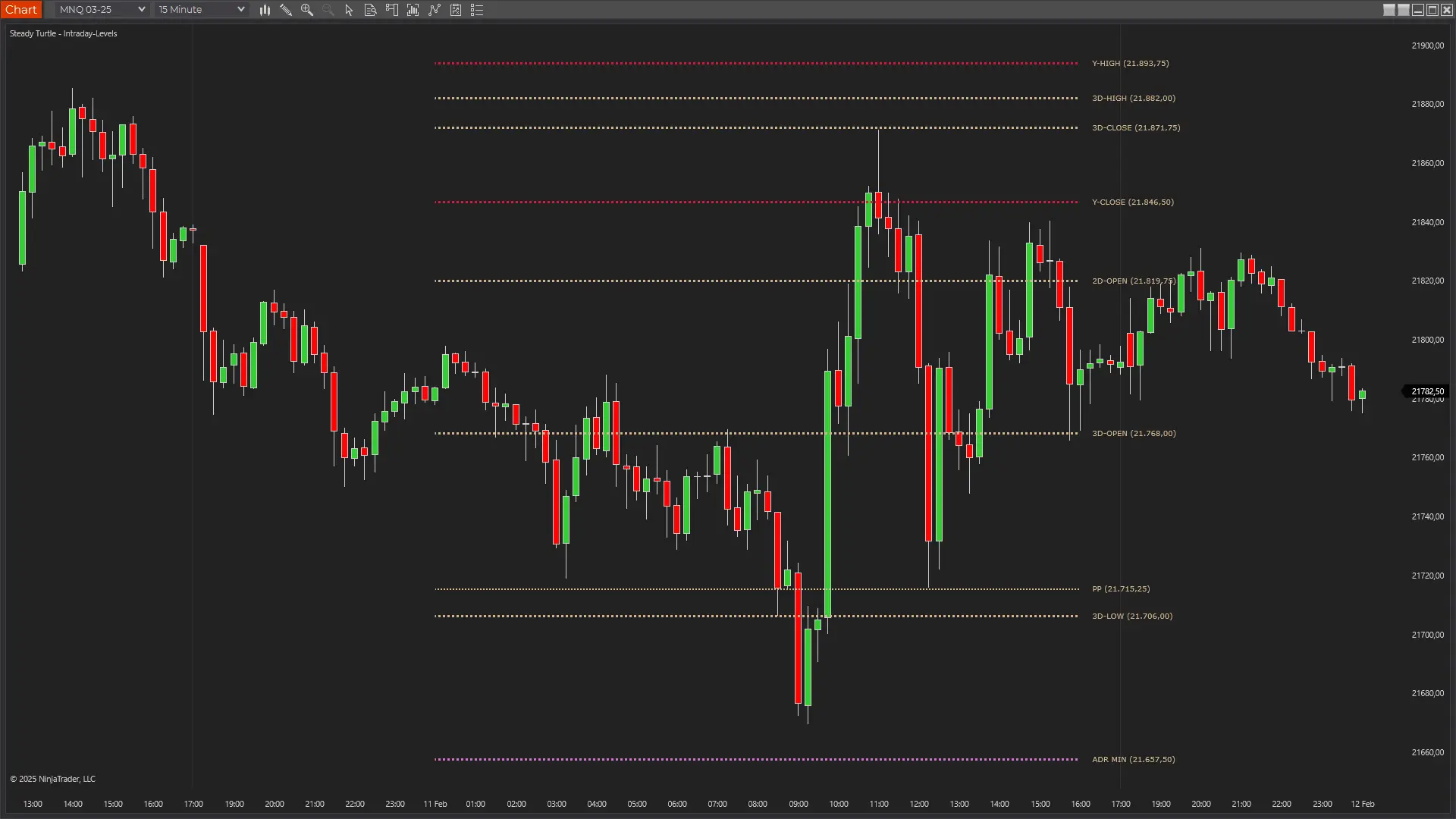
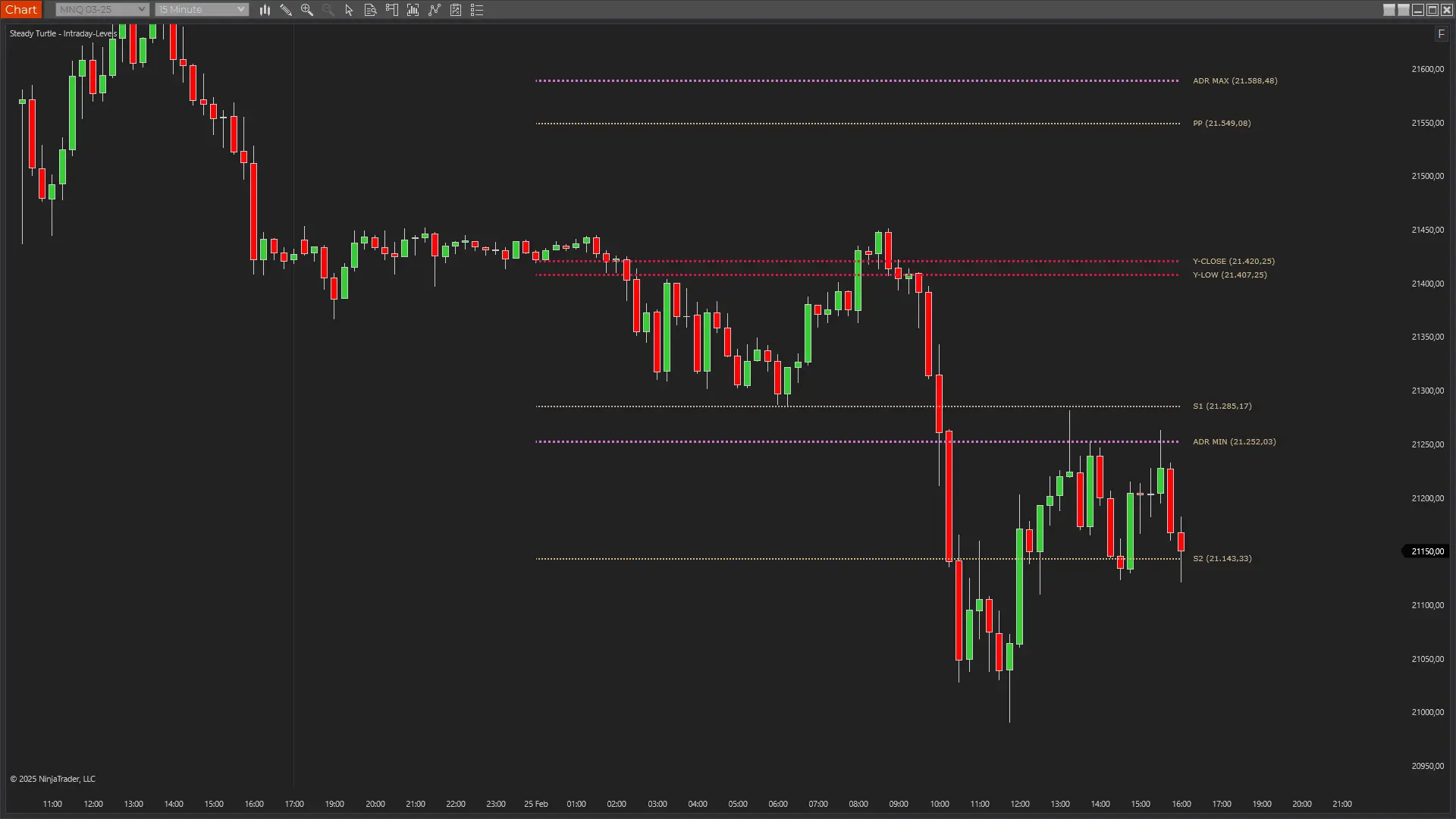
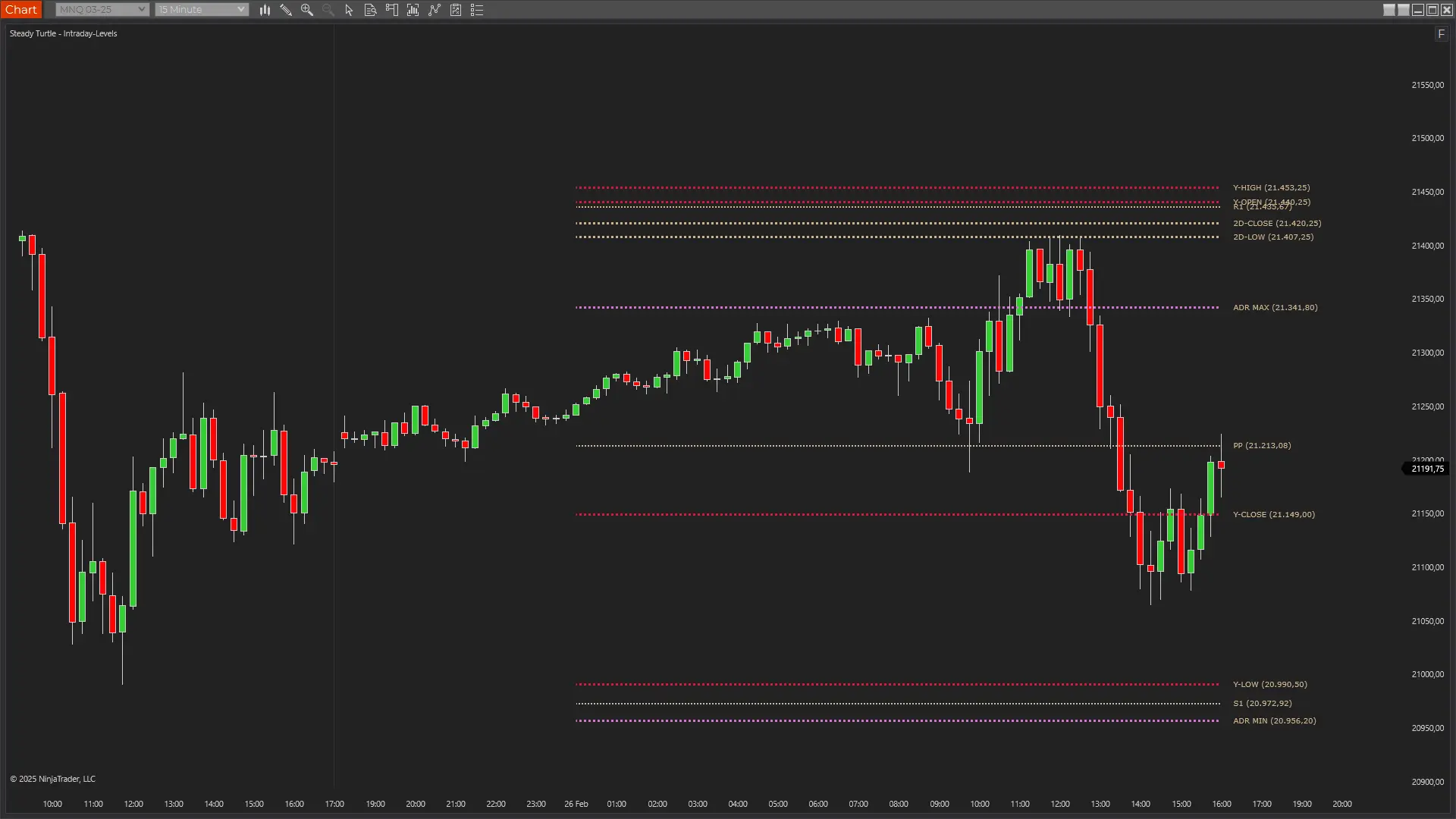
Three MNQ sessions — a confluence cluster, a full-day OHLC stack, and a Y-OPEN-to-R2 bracket.

MNQ 06-26 · RTH · 5m

Two categories, same price.

MNQ where Yesterday's High and pivot R1 sit four ticks apart, price tests the cluster, breaks, and runs to R2

When level types stack, the tape pays attention.

Y-HIGH (26902) and R1 (26898) sit four ticks apart — a prior-day reference and a pivot extension landing on the same shelf. Price spends the morning below, presses into the cluster around 10:00, breaks through cleanly, and the breakout doesn't stop until R2 (27075) catches it five hours later. That's the practical case for keeping more than one level category on the chart: confluence between independent calculations is rare, and when it happens, it's the trade.
MNQ 06-26 · RTH · 5m

Y-HIGH on top, S1 on the bottom.

MNQ session bracketed by Yesterday's High, pivot points, and S1 — the entire day's range pre-drawn

The whole range, mapped before the bell.

Morning rally tags Y-HIGH (27138) at 11:30 and rolls. PP (26990) holds for an hour, then breaks at 13:00 and the flush extends straight to S1 (26843). The low-print wick stops one tick from Y-LOW (26728) before the rebound. Five categories — Y-HIGH, Y-CLOSE, PP, S1, Y-LOW — and every meaningful turn of the session happened within ticks of one of them. The day's geometry was on the chart at 09:30.

MNQ 06-26 · RTH · 5m

Y-OPEN floor, R2 ceiling.

MNQ holding above Yesterday's Open in the morning then rallying into pivot R2 and ranging sideways

Different categories braced both ends of the day.

Morning sells off and bottoms within ticks of Y-OPEN (27080) — a prior-day price, not a calculated one. The rally then pushes through a tight cluster of ADR MAX, Y-HIGH, and R1 in the 27130–27172 zone, and runs straight into R2 (27402). From there, sideways: every push fails at R2, every dip holds above. One level type called the floor, another called the ceiling, and the indicator drew both before the open.

§ 03 · The Receipts What traders say

What traders actually say.

No curated five-star walls. Three quotes, three different reasons this one stays on the chart.

Saves me fifteen minutes every morning. Pivots, yesterday's high and low, ADR — all already calculated when I open the chart. I used to do this by hand on a sticky note.
— Verified buyer
The weekly levels are slept on. When a daily pivot lines up with the prior week's high, that's the trade. Three confluences at the same price beats any single indicator.
— Verified buyer
Those ADR projections changed my trade management. I used to hold for crazy targets. Now if price has already done 80% of the average day, I'm trimming — not adding.
— Verified buyer
§ 04 · Pricing One-time · No discounts · No expiry

One indicator. Or twelve.

The math writes itself. À la carte is $49. The bundle is $299 for everything — including every indicator I ship next year.

Intraday Key Levels

Buy this one indicator standalone.

$49
One-time
  • Any paid indicator à la carte
  • Lifetime updates for that tool
  • One user license (works on multiple machines)
  • Email support
  • Other indicators
  • Future releases
Editor's Pick

Complete Bundle

All 12 indicators, every future release, forever.

$299
One-time
  • All 12 current indicators
  • Every future indicator, free
  • Lifetime updates
  • One user license (works on multiple machines)
  • Priority support
  • One-time payment, no subscriptions

$24.92 per tool · vs $49 à la carte

One-Time Purchase Lifetime Updates NT8 8.1.6+
§ 05 · Questions Objection handler

A few things first.

Everything traders ask me before they buy. If yours isn't here, email me →.

Classic floor-trader pivots. The central pivot is PP = (H + L + C) / 3 from the prior day. Support and resistance levels derive from there: R1 = 2·PP − L, S1 = 2·PP − H, and the R2/S2/R3/S3 extensions follow the standard formulas. No weighting, no proprietary math — the same numbers any other pivot tool would compute.
ADR is the five-day average of daily high-to-low range. By default the indicator draws ADR Max = prior close + ADR/2 and ADR Min = prior close − ADR/2, centering the expected range on yesterday's close. There's also a SessionExtremes mode (low + ADR / high − ADR) if you prefer projecting from the current session's extreme as it forms.
Seven categories, each independently toggleable: (1) daily pivots — PP, R1/R2/R3, S1/S2/S3; (2) yesterday's OHLC; (3) two-day-ago OHLC; (4) three-day-ago OHLC; (5) prior week's OHLC; (6) ADR Max/Min projections; (7) level labels with optional price values. Flip off the ones you don't watch.
Five trading days minimum for the ADR calculation and the multi-day levels; the prior full week for the weekly OHLC. Twenty-plus days is the safe default — set Days to load on the chart to 30 and everything computes on the first bar of the session.
Any instrument NT8 can chart — ES, NQ, MES, MNQ, CL, GC, 6E, equities, FX. Pivots and prior-day levels work anywhere there's a daily bar; ADR needs enough historical daily data to compute the five-day average. Defaults are tuned for futures but the math is instrument-agnostic.
Yes, every edition — Free NT8, NT8 Lifetime License, and every tier in between. The only requirement is NinjaTrader 8 version 8.1.6 or newer — that's the build where NinjaTrader introduced email-based licensing, which the indicator uses to authenticate. Older builds can't authenticate; update via NT8's Control Center → Help → Check for Updates first if you're on an earlier version.
Yes — anywhere you sign in to NinjaTrader 8 with your user email. The license is tied to your NT8 user, not the machine, so desktop, laptop, and VPS all work the same. One user, unlimited machines.
Yes, lifetime updates. Every new version is free forever. If you buy the Complete Bundle, every future indicator I ship is also included at no extra cost.
Indicators are non-refundable — once you download, the software is yours to keep. Two ways to de-risk before buying: (a) try any of the free indicators first to confirm they load and run on your setup, and (b) email me with any pre-purchase questions at info@steady-turtle.com.
§ 06 · Settings Reference For the record

Every knob, exposed.

For the traders who need to know every knob before buying — here's what ships in the settings panel, and what it does.

Name Default What it does
Show Pivots True Toggle daily pivot levels (PP, R1–R3, S1–S3) on or off.
Show Yesterday True Toggle yesterday's open, high, low, and close as horizontal lines.
Show Daily Levels True Toggle two-day-ago and three-day-ago OHLC levels — useful for slower instruments.
Show Weekly Levels True Toggle prior-week OHLC. Higher-timeframe context for swing bias.
Show ADR Levels True Toggle the ADR Max / ADR Min range projection.
ADR Calc Mode CloseCentered CloseCentered = prior close ± ADR/2. SessionExtremes = session low + ADR / session high − ADR, recomputed live.
Extend Lines Until (ET) 16:00 Lines stop extending at this Eastern-Time clock — keeps overnight charts clean.
Max Sessions 5 How many historical sessions of levels to keep on the chart (1–50).
Pivots Color Tan Stroke color for the PP + R/S pivot lines.
Pivots Line Style Dot Dash style for the pivot lines.
Pivots Line Width 2 Pixel width for the pivot lines (1–10).
Yesterday Color Crimson Stroke color for yesterday's OHLC. Defaults to the most prominent of the level groups.
Yesterday Line Style Dot Dash style for the yesterday OHLC lines.
Yesterday Line Width 3 Pixel width for the yesterday OHLC lines (1–10).
Daily Color Tan Stroke color for 2D and 3D OHLC levels.
Daily Line Style Dot Dash style for the 2D/3D OHLC lines.
Daily Line Width 3 Pixel width for the 2D/3D OHLC lines (1–10).
Weekly Color Tan Stroke color for prior-week OHLC.
Weekly Line Style Dot Dash style for the prior-week OHLC lines.
Weekly Line Width 3 Pixel width for the prior-week OHLC lines (1–10).
ADR Color Orchid Stroke color for the ADR Max / Min projections.
ADR Line Style Dot Dash style for the ADR projection lines.
ADR Line Width 3 Pixel width for the ADR projection lines (1–10).
Show Labels True Level labels next to each line.
Show Price True Append numeric price values to the level labels.
Label Color Tan Color for level labels.
Debug Mode False Print diagnostic info to the NinjaScript output window. Off unless you are troubleshooting.

Stop marking levels by hand.

$49 buys the indicator. $299 buys all twelve — plus every one I ship next year. Either way, one payment, no subscription, and it runs wherever you log into NinjaTrader.

4.8/5 1,200+ futures traders
ONE-TIME · LIFETIME UPDATES · NT8 8.1.6+
Risk Disclosure

Futures and forex trading contains substantial risk and is not for every investor. An investor could potentially lose all or more than the initial investment. Risk capital is money that can be lost without jeopardizing ones' financial security or life style. Only risk capital should be used for trading and only those with sufficient risk capital should consider trading. Past performance is not necessarily indicative of future results.

Testimonials appearing on this website may not be representative of other clients or customers and is not a guarantee of future performance or success.

Hypothetical Performance Disclosure

Hypothetical performance results have many inherent limitations, some of which are described below. No representation is being made that any account will or is likely to achieve profits or losses similar to those shown; in fact, there are frequently sharp differences between hypothetical performance results and the actual results subsequently achieved by any particular trading program. One of the limitations of hypothetical performance results is that they are generally prepared with the benefit of hindsight. In addition, hypothetical trading does not involve financial risk, and no hypothetical trading record can completely account for the impact of financial risk of actual trading. For example, the ability to withstand losses or to adhere to a particular trading program in spite of trading losses are material points which can also adversely affect actual trading results. There are numerous other factors related to the markets in general or to the implementation of any specific trading program which cannot be fully accounted for in the preparation of hypothetical performance results and all which can adversely affect trading results.